David runs a successful B2B software company generating $4 million in annual revenue. His website attracts 15,000 qualified visitors monthly, but only 1.8% convert to demo requests. He’d spent months trying to improve this number through traditional A/B testing: different button colors, headline variations, form field adjustments. The results were disappointing. Most tests showed no significant difference, and the few winners delivered modest 3-5% improvements that took six weeks to validate.
Then David’s marketing director suggested something radical: using predictive AI to identify which visitors were most likely to convert, then automatically personalizing their experience. Within 30 days, their conversion rate jumped to 2.9%, a 61% increase. More remarkably, the AI identified patterns no human would have spotted. It discovered that visitors arriving between 2-4 PM on Tuesdays who spent more than 90 seconds on the pricing page but less than 30 seconds on the features page had a 12% conversion probability. The system automatically served these visitors a simplified demo signup form that cut fields from nine to three, which converted at 18%.
The revenue impact was immediate. That 1.1 percentage point conversion improvement translated to 1,980 additional demos annually. At David’s 22% demo-to-customer close rate and $45,000 average contract value, this single AI-driven optimization generated $19.6 million in additional pipeline.
David’s experience illustrates a fundamental shift happening in conversion rate optimization. Traditional CRO approaches treat all visitors identically and require weeks of testing to validate small improvements. AI-powered CRO identifies micro-segments of visitors with distinct behaviors and preferences, then delivers personalized experiences that convert significantly better, while predictive models forecast outcomes and prioritize tests that will generate the biggest revenue impact.
For businesses serious about growth, AI isn’t just improving CRO anymore. It’s completely rewriting what’s possible.
Why Traditional CRO Reaches a Ceiling (And How AI Breaks Through)
Most businesses eventually hit a conversion rate ceiling that feels impossible to break through. You’ve optimized the obvious elements. Your site loads quickly, your value proposition is clear, your checkout process is streamlined. Yet conversion rates stubbornly plateau around industry averages.
This ceiling exists because traditional CRO operates within significant constraints that limit what’s achievable.
- Statistical significance requirements create a brutal time tax. Before you can confidently declare a test winner, you need enough conversions in both variants to achieve statistical significance (typically 95% confidence). For most businesses, this means running tests for 2-6 weeks. If you have a 2% conversion rate and 10,000 monthly visitors, you generate only 200 conversions monthly. Testing a single element properly requires 4-6 weeks, meaning you can only validate 8-12 ideas annually.
- The one-size-fits-all approach ignores visitor diversity. When you show every visitor the same experience, you’re optimizing for the average visitor—who doesn’t actually exist. Your audience includes first-time visitors and returning customers, mobile users and desktop browsers, different industries, company sizes, job titles, and stages of purchase readiness. A headline that resonates with enterprise buyers might confuse small business owners. A detailed feature comparison helps technical evaluators while overwhelming business decision-makers.
- Human intuition about what will convert is unreliable. Studies consistently show that even experienced marketers guess wrong about which variations will win more than 60% of the time. We overestimate the impact of design changes (button colors, layout tweaks) while underestimating the power of messaging shifts, offer restructuring, and personalization. This leads teams to waste testing budget on low-impact experiments.
- Sequential testing dramatically slows learning velocity. Traditional CRO runs one test at a time to avoid interaction effects that muddy results. But running tests sequentially means insights accumulate slowly. A team might spend an entire quarter testing just four variations on a single page.
AI-powered CRO systematically eliminates each of these constraints. Machine learning models identify winning variations faster by continuously allocating more traffic to better-performing experiences, reducing time to significance by 40-70%. Predictive algorithms segment visitors into dozens of micro-audiences and personalize experiences for each group simultaneously. AI analyzes thousands of attribute combinations to identify non-obvious patterns that predict conversion likelihood. Multi-armed bandit algorithms run multiple experiments simultaneously, maximizing learning speed while minimizing opportunity cost.
The result is businesses breaking through conversion rate ceilings they’d hit years ago:
- Companies stuck at 2% conversion rates reach 3.5-4.5%.
- E-commerce sites plateaued at 3% push toward 5-6%.
The revenue impact of these improvements compounds dramatically over time.

Three Types of AI That Transform Conversion Performance
AI isn’t a single technology but rather a category encompassing several distinct approaches. Understanding which type addresses which CRO challenge helps businesses deploy the right solutions for their specific situations.
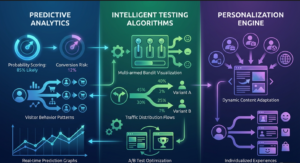
Type 1: Predictive Analytics That Forecast Conversion Likelihood
Predictive AI analyzes visitor behavior in real-time to calculate the probability that each individual will convert. These models process hundreds of signals simultaneously, including referral source and UTM parameters, page sequence and dwell time on specific sections, scroll depth and engagement patterns, previous visit history and recency, device type and browser, geographic location and time of day, and form interaction patterns like hesitation or abandonment.
The model assigns each visitor a conversion probability score ranging from near-zero (extremely unlikely to convert) to high (strong conversion intent). This score updates continuously as the visitor navigates your site.
Businesses use these predictions to trigger interventions at optimal moments. When a high-intent visitor shows exit signals (cursor movement toward the back button or URL bar), the system might display a targeted offer or chat prompt. When a low-intent visitor spends time on educational content, the system prioritizes lead magnet offers over aggressive sales pitches. When medium-intent visitors abandon forms, the system sends personalized follow-up emails addressing likely concerns.
The predictive accuracy of these models improves continuously. Early implementations might achieve 65-70% accuracy (correctly predicting whether a visitor will convert in 65-70% of cases). After training on six months of data, accuracy typically reaches 78-85%. For businesses with substantial traffic, this precision enables remarkably effective intervention strategies.
Consider an e-commerce business selling premium outdoor gear. Their predictive model identifies that visitors viewing 5+ product pages, spending significant time comparing specifications, and repeatedly returning to the same product category over multiple sessions have an 82% probability of purchasing within seven days. The business automatically enrolls these high-intent visitors in a targeted email sequence highlighting customer reviews, answering common objections, and offering a time-limited 10% discount. This intervention converts 34% of recipients, dramatically higher than their 2.8% site-wide conversion rate.
Type 2: Intelligent Testing That Accelerates Learning and Maximizes Revenue
Traditional A/B testing waits until statistical significance is achieved before declaring a winner, treating all traffic equally throughout the test. AI-powered testing uses multi-armed bandit algorithms that continuously shift traffic toward better-performing variations as data accumulates, reducing the opportunity cost of showing underperforming variants.
Here’s how this works in practice. You create three variations of a landing page headline. A traditional A/B test splits traffic evenly—33% to each variant—until significance is reached (typically 4-6 weeks). If Variant B is clearly outperforming the others after 10 days, you still waste two-thirds of your traffic on inferior variants for another 2-4 weeks.
An AI-powered bandit algorithm starts with even traffic distribution but continuously reallocates traffic as conversion data accumulates. After three days, if Variant B is performing best, the algorithm might shift to 50-30-20 distribution. After seven days, it might move to 70-20-10. By the time statistical confidence is reached, 60-70% of test traffic already experienced the winning variant, dramatically reducing the revenue lost to underperforming variants.
The revenue difference between these approaches is substantial. A business with $100,000 in monthly revenue from the tested page would lose $15,000-20,000 in a traditional test (two to three weeks showing inferior variants to two-thirds of visitors). The same business using bandit algorithms might lose only $3,000-5,000, capturing $12,000-15,000 in additional revenue from the same test.
Beyond revenue protection, intelligent testing algorithms identify winning variations faster. What traditionally required six weeks might reach significance in 2-3 weeks, effectively tripling your testing velocity.
Type 3: Personalization Engines That Deliver Individualized Experiences
The most sophisticated AI CRO systems combine predictive analytics and intelligent testing with real-time personalization, dynamically adjusting what each visitor sees based on their specific characteristics and behaviors.
These systems maintain hundreds of page variants simultaneously, each optimized for a specific visitor segment. A B2B SaaS company might serve different experiences to first-time visitors versus returning prospects, enterprise-level companies versus small businesses, visitors from paid search versus organic traffic, technical decision-makers versus business buyers, and visitors in the awareness stage versus those ready to purchase.
The AI determines which variant to show each visitor by analyzing their characteristics in real-time, then serves the statistically optimal experience for that visitor profile. This approach dramatically outperforms traditional segmentation because the AI identifies non-obvious micro-segments that humans wouldn’t create manually.
A financial services company implemented AI personalization across their loan application funnel. The system identified 47 distinct visitor segments with meaningfully different conversion patterns. One surprising segment was mobile visitors aged 35-44 who arrived from Facebook ads late in the evening (8-11 PM). This group converted at 4.2% when shown a simplified three-step application versus 1.1% with the standard seven-step process. The AI automatically served the simplified version to this segment, capturing conversions that would have otherwise been lost.
The cumulative effect of serving optimized experiences to dozens of micro-segments compounds into significant conversion rate improvements.
The Simple Tests That Generate Revenue Impact
While AI enables sophisticated personalization, some of the highest-ROI improvements come from simple tests enhanced by AI’s pattern recognition capabilities. These represent the quick wins every business should prioritize.
Test 1: Dynamic Form Optimization
Form abandonment represents one of the largest conversion leaks for most businesses. The average form abandonment rate hovers around 68%, meaning two-thirds of people who start filling out your form never complete it.
AI analyzes form interaction patterns to identify which fields cause abandonment. Is it asking for phone numbers that makes people exit? Does requesting company revenue feel too intrusive? Do custom dropdowns confuse mobile users?
Based on these insights, AI-powered forms dynamically adjust what’s shown. High-intent visitors (those who’ve visited multiple times, spent significant time on pricing, or arrived from high-intent search terms) see simplified forms with minimal fields. Low-intent visitors (first-time browsers from social media) might see even fewer fields or alternative offers better suited to their stage.
Progressive disclosure further improves completion rates. Rather than showing all fields at once, the form reveals them sequentially after each completion. This psychological technique makes the process feel less overwhelming while allowing the AI to customize which additional fields appear based on information already provided.
A B2B marketing agency implemented dynamic form optimization powered by AI. Their standard contact form required nine fields. The AI discovered that form completion rates varied dramatically by visitor source. Organic search visitors completed the nine-field form at 42%, but paid social visitors completed it at only 18%. The system automatically served paid social visitors a three-field variant, boosting completion rates to 51%. This single optimization generated 287 additional qualified leads quarterly.
Test 2: Intelligent Timing of Offers and Interventions
When you present an offer matters as much as what you offer. Present a discount popup immediately upon page load, and you annoy visitors who haven’t yet understood your value. Wait too long, and high-intent visitors exit before seeing your offer.
AI-powered timing optimization monitors visitor behavior signals to determine optimal intervention moments. These signals include time on page and scroll depth, mouse movements indicating exit intent, page interaction patterns like clicking tabs or playing videos, return visit frequency and recency, and behavioral indicators of purchase readiness.
The system triggers offers, chat prompts, or other interventions when the probability of positive response is highest. For some visitors, this might be after 45 seconds of engaged reading. For others, it might be at the moment they view pricing for the third time.
An e-commerce retailer selling home fitness equipment tested AI-powered timing for their cart abandonment popup. Previously, they displayed the offer (10% discount) when visitors moved their cursor toward the browser close button. The AI discovered that this intervention actually reduced conversions among high-intent visitors (those with multiple items in cart, who’d viewed product reviews, and compared multiple products). These visitors perceived the popup as manipulative or assumed better discounts were available if they waited.
The system automatically suppressed the popup for high-intent visitors while showing it to medium and low-intent segments. Paradoxically, showing fewer popups increased revenue by 18% because they stopped interrupting buyers who were already committed to purchasing.
Test 3: Personalized Social Proof and Trust Signals
Different visitors care about different trust signals. Enterprise buyers want security certifications and compliance badges. Small business owners prioritize testimonials from similar-sized companies. Technical evaluators seek detailed specifications and integration capabilities. Budget-conscious shoppers respond to price comparisons and value guarantees.
AI identifies which trust signals resonate with each visitor segment, then prominently displays relevant proof while minimizing less relevant elements.
A B2B software company selling project management tools implemented this approach. Their product page initially showed trust signals in a fixed sequence: enterprise client logos, industry awards, security certifications, G2 ratings, and customer testimonials. Every visitor saw identical positioning and prominence.
The AI discovered that visitors from small companies (1-50 employees) rarely noticed or cared about enterprise logos, but they spent significant time reading testimonials from similar-sized businesses. Meanwhile, visitors from large enterprises (1,000+ employees) fixated on security certifications and compliance badges while largely ignoring small business testimonials.
The system automatically reordered trust signals based on visitor company size, prominently featuring elements most relevant to each segment. Small business visitors saw testimonials first, while enterprise visitors saw certifications and compliance badges at the top.
Building Your AI-Powered CRO System: A Practical Implementation Framework
Most businesses assume implementing AI for CRO requires expensive enterprise software, large data science teams, and months of setup. The reality is far more accessible. Here’s how to implement AI-powered CRO in stages, starting with tools available at modest budgets.
Stage 1: Foundation—Data Infrastructure and Tracking (Weeks 1-2)
AI requires clean, comprehensive data to identify patterns and make accurate predictions. Before implementing any AI tools, ensure your tracking infrastructure captures the signals that matter.
Essential data points include every visitor’s complete page path and sequence, time spent on each page and scroll depth, form interactions including field hesitations and partial completions, traffic source details (UTM parameters, referral sources), device type, browser, and operating system, geographic location and time zone, and returning visitor identification and history.
Most businesses already collect some of this through Google Analytics, but AI requires event-level granularity that standard GA4 implementations often miss. Implement enhanced event tracking for form field interactions, scroll milestones (25%, 50%, 75%, 100%), video plays and engagement, content section views (which accordion tabs were opened, which comparison tables were expanded), and exit intent indicators.
Tools like Segment, Mixpanel, or Amplitude excel at capturing this behavioral data and making it accessible to AI platforms. The investment here (typically $500-2,000 monthly for mid-sized businesses) pays dividends across every subsequent AI implementation.
Stage 2: Predictive Analytics for High-Intent Visitor Identification (Weeks 3-6)
Once data infrastructure is solid, implement predictive models that identify high-intent visitors in real-time. These visitors represent your most valuable traffic—they’re already close to converting, and even small nudges dramatically increase conversion probability.
Several accessible platforms provide predictive conversion scoring without requiring data science expertise. Platforms like Intellimize, Dynamic Yield, or Mutiny train models on your specific data to identify high-conversion probability visitors. These tools typically provide a simple probability score (0-100) indicating how likely each visitor is to convert.
Start by using these predictions to trigger simple interventions. When a high-intent visitor shows exit signals, display a targeted offer or chat prompt. When a medium-intent visitor hesitates on your form, reduce required fields. When a low-intent visitor browses educational content, offer a relevant lead magnet rather than pushing for a sales conversation.
The implementation effort is modest (2-4 weeks for most businesses) but the revenue impact is immediate. Companies typically see 15-30% conversion rate improvements from predictive scoring alone, before implementing any additional AI capabilities.
Stage 3: Multi-Armed Bandit Testing (Weeks 7-12)
Replace traditional A/B testing with intelligent algorithms that maximize revenue while testing. Most major testing platforms now offer bandit algorithms as an option, including Google Optimize, Optimizely, VWO, and Convert.com.
Start with high-traffic pages where traditional testing was already a priority: your primary landing pages, checkout or signup flows, and pricing pages. Create 2-4 variants testing meaningful differences (messaging, offer structure, form design) rather than superficial changes (button colors, font sizes).
Configure the bandit algorithm to begin with even traffic distribution but continuously shift traffic toward better performers as data accumulates. Most platforms allow you to set confidence thresholds (typically 90-95%) that determine when the algorithm declares a winner and fully switches traffic.
The beauty of bandit algorithms is they require no additional implementation effort beyond what traditional A/B testing demands. You simply select “multi-armed bandit” rather than “standard split test” in your platform settings. The revenue protection happens automatically, with minimal opportunity cost from showing inferior variants.
Stage 4: Dynamic Personalization for Visitor Segments (Weeks 13-20)
Once predictive analytics and intelligent testing are operational, layer in personalization that serves different experiences to different visitor segments.
Start with 3-5 broad segments that represent meaningfully different audiences. For B2B companies, this might include small business versus enterprise, new visitors versus returning, organic search versus paid traffic, or technical roles versus business roles. For e-commerce, consider first-time visitors versus returning customers, high-value cart versus low-value cart, mobile versus desktop, or geographic segments with different preferences.
For each segment, create variants optimized for their specific needs and preferences. This doesn’t require building entirely different pages. Often, personalization involves adjusting headlines to reflect segment priorities, reordering content sections or trust signals, modifying form fields and calls-to-action, or changing imagery to reflect segment demographics.
AI platforms handle the technical complexity of serving the right variant to each visitor. You simply define the segments and create the variants, then the system automatically delivers personalized experiences.
Businesses implementing comprehensive personalization typically see incremental conversion improvements of 20-40% beyond gains from predictive analytics and intelligent testing. The cumulative effect of all three stages often doubles or triples baseline conversion rates.
The Hidden Revenue Multiplier: AI Identifies Opportunities Humans Miss
Perhaps the most valuable aspect of AI-powered CRO isn’t any single technique but rather the pattern recognition capability that discovers non-obvious optimization opportunities.
Humans naturally think in simple categories and linear relationships. We test whether changing a button from blue to green improves conversions. We segment audiences by obvious demographics. We assume relationships are straightforward: longer forms reduce conversions, faster load times increase conversions, more information helps technical buyers.
AI analyzes multidimensional patterns across hundreds of variables simultaneously, identifying complex interactions that humans wouldn’t notice. These discoveries often surprise experienced marketers and deliver outsized improvements.
An e-commerce company selling outdoor apparel discovered through AI analysis that customers purchasing winter jackets had dramatically different conversion patterns than those buying other products. Counter-intuitively, showing winter jacket shoppers longer, more detailed product pages with extensive specifications increased conversions by 34%, while the same approach reduced conversions for other product categories. The AI identified that winter jacket buyers were planning significant purchases for specific activities (backcountry skiing, mountaineering, arctic expeditions) and craved detailed information to ensure the right choice. Other shoppers preferred streamlined experiences.
A SaaS company’s AI uncovered that demo requests surged on Wednesdays between 2-4 PM, but these demos converted to paid customers at only 8%, far below the 23% average. Further analysis revealed these were “tire-kicker” requests from people browsing during slow work afternoons but lacking genuine purchase intent. The AI automatically adjusted form requirements for Wednesday afternoon requests, adding qualification questions that filtered out low-intent prospects while making it easier for genuine buyers. This reduced Wednesday demo volume by 40% but increased conversion rates to 19%, generating more revenue with fewer resources spent on unqualified demos.
These insights emerge from analyzing millions of interaction patterns across thousands of visitors. No human could manually process this volume of data or identify such subtle correlations. This is where AI’s value extends beyond automating existing processes to fundamentally expanding what’s knowable about your customers.
Why AI-Powered CRO Delivers Compounding Returns
Most marketing optimizations provide one-time improvements. You redesign your website and conversion rates jump 20%, then plateau at the new level. AI-powered CRO is different. The systems improve continuously as they accumulate data and refine predictions.
This creates compounding returns that accelerate over time. In month one, you might see a 15% conversion rate improvement as the AI learns basic patterns. By month six, improvements might reach 35% as the system identifies more nuanced segments and opportunities. By month twelve, gains of 50-80% become achievable as predictive accuracy reaches 80%+ and personalization strategies mature.
This compounding effect means the revenue impact grows exponentially rather than linearly. A business generating $1 million monthly revenue that implements AI-powered CRO might see these progression milestones: month 3 at $1.15 million monthly revenue (15% improvement), month 6 at $1.35 million (35% improvement), month 12 at $1.65 million (65% improvement), and month 24 at $2.05 million (105% improvement).
The system’s learning velocity increases with scale. More traffic generates more data, enabling more precise predictions and faster testing. More conversions create tighter feedback loops. More segments identified lead to more personalization opportunities. The virtuous cycle accelerates as the business grows.
How Concinnity Limited Implements AI-Powered CRO for Maximum Revenue Impact
Building effective AI-powered CRO systems requires expertise spanning data infrastructure, machine learning, experimentation methodology, and conversion psychology. Most businesses lack this combination of skills in-house, which is exactly why Concinnity Limited has built specialized capabilities in AI-driven CRO implementation.
Our approach begins with comprehensive conversion audits that identify where revenue is currently leaking from your funnel. We analyze your entire customer journey from first visit through conversion, quantifying abandonment at each stage and prioritizing opportunities by revenue impact. This ensures we focus on changes that move the needle, not vanity optimizations.
- We then design and implement your AI infrastructure, selecting platforms matched to your specific needs, budget, and technical capabilities. For businesses with modest traffic (under 50,000 monthly visitors), we might recommend accessible tools like Intellimize or Mutiny that provide predictive analytics and personalization without requiring data science teams. For high-traffic businesses (200,000+ monthly visitors), we might implement custom solutions using platforms like Google Cloud AI or AWS Personalize that offer maximum flexibility and sophistication.
- Our team handles the technical complexity of integrating these systems with your existing martech stack. AI platforms need to connect with your CRM, analytics tools, email platforms, and content management systems to deliver seamless personalization. We ensure these integrations work reliably and data flows correctly between systems.
- Most importantly, we focus relentlessly on revenue outcomes rather than activity metrics. Our success is measured by increases in your qualified conversions, pipeline generated, and revenue attributed to CRO improvements. We establish clear baseline metrics, set realistic improvement targets based on your industry and traffic patterns, and track progress weekly to ensure the AI implementation delivers promised results.
We’ve helped businesses across industries unlock substantial hidden revenue through AI-powered CRO. A B2B software company increased trial signups by 67% while simultaneously improving trial-to-paid conversion rates by 31%, generating $3.8 million in additional ARR. An e-commerce retailer boosted purchase conversion rates from 2.4% to 4.1% while increasing average order value by 18%, resulting in $12 million additional annual revenue.
Schedule a free CRO assessment to discover how much revenue is currently hidden in your conversion funnel. We’ll analyze your traffic patterns, identify your highest-leverage opportunities, and show you exactly what’s possible with AI-powered optimization.
FAQ
1. How much traffic do I need before AI-powered CRO makes sense?
AI requires data to identify patterns and make accurate predictions. As a general rule, you need at least 10,000 monthly website visitors and 50+ monthly conversions to generate meaningful insights. Below these thresholds, traditional CRO methods are often more appropriate.
However, even businesses with modest traffic can benefit from some AI capabilities. Predictive analytics work with lower traffic volumes than full personalization systems. If you’re generating 5,000+ monthly visitors, you can still implement intelligent testing and basic visitor scoring.
2. Will AI replace the need for human CRO expertise?
No. AI is a tool that amplifies human expertise, not a replacement for it. AI excels at pattern recognition, prediction, and optimization at scale, but humans are still essential for strategy development, creative direction, understanding business context, interpreting results, and ethical oversight.
The most effective CRO programs combine AI’s computational power with human creativity and strategic thinking. AI identifies opportunities and optimizes execution, while humans provide the strategic vision and ensure optimization aligns with brand values and business goals.
3. How long before I see results from AI-powered CRO?
Initial results typically appear within 30-60 days of implementation. You’ll see early improvements from predictive analytics identifying high-intent visitors and intelligent testing reducing opportunity costs. More substantial gains emerge over 3-6 months as the AI accumulates data and refines personalization strategies.
The most dramatic improvements occur in months 6-12 as predictive accuracy reaches 75-85% and the system identifies increasingly nuanced optimization opportunities. Businesses should think of AI-powered CRO as a long-term investment that compounds over time rather than a quick fix.
4. What’s the typical ROI of implementing AI for CRO?
ROI varies significantly based on your current conversion rates, traffic volume, and average customer value. Most businesses see 3-8x return on investment within the first year. A company spending $5,000 monthly on AI-powered CRO tools and implementation might generate $15,000-40,000 in additional monthly revenue.
Higher-traffic businesses with higher-value conversions see even stronger returns. An enterprise SaaS company with 200,000 monthly visitors and $50,000 average contract values might invest $20,000 monthly in comprehensive AI CRO but generate $400,000+ in additional monthly pipeline.
5. Can AI-powered CRO work for e-commerce and B2B equally well?
Yes, though the specific applications differ slightly. E-commerce benefits particularly from product recommendation engines, dynamic pricing optimization, cart abandonment prediction and prevention, and personalized product merchandising.
B2B companies see strong results from lead scoring and prioritization, personalized content based on industry and company size, dynamic form optimization for different buyer stages, and sales enablement through behavioral intelligence.
Both sectors achieve substantial conversion rate improvements, typically in the 25-70% range after full implementation.
6. What are the risks or downsides of AI-powered CRO?
The main risks include over-optimization for short-term conversions at the expense of customer quality, privacy concerns if personalization feels intrusive or creepy, technical complexity requiring specialized expertise to implement correctly, and dependence on quality data (garbage in equals garbage out).
These risks are manageable with proper implementation. Focus on optimizing for qualified conversions rather than maximizing raw conversion numbers. Be transparent about data usage and give customers control. Work with experienced partners who understand both the technical and strategic aspects.
7. How does AI-powered CRO comply with privacy regulations like GDPR?
Properly implemented AI CRO systems can fully comply with GDPR, CCPA, and other privacy regulations. The key is using privacy-preserving approaches like anonymized behavioral tracking without storing personally identifiable information, clear consent mechanisms for data collection, data minimization practices that collect only necessary information, and transparent disclosure of how AI personalizes experiences.
Many AI platforms offer privacy-compliant implementations that don’t require personally identifiable information. They personalize based on behavioral patterns and session data rather than individual user tracking.
References