Sarah manages growth for a mid-size B2B SaaS company. Last quarter, her Google Analytics told a story that made no sense on the surface. Monthly visitors were down 18%. But demo requests were up 31%. Revenue from new customers had grown 24%.
Her first instinct was to panic about the traffic drop. Her second, after digging into the data, was to order coffee and rethink everything she knew about conversion rate optimisation.
What Sarah stumbled into is one of the most significant shifts in digital marketing right now. AI-powered search , Google’s AI Overviews, ChatGPT, Perplexity, and others , is quietly filtering the internet for users before they ever reach your website. The people who still click through?
They already know what they want. They arrive with context, intent, and considerably less patience for friction.
This changes the job of CRO fundamentally. When visitors are pre-qualified by AI, the task is no longer convincing strangers , it’s aligning your experience to meet an expectation that was already formed somewhere else.
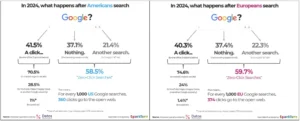
69% of Google searches now end without a single click , up from 56% just one year earlier.
The Numbers Behind the Shift
The change is real, measurable, and accelerating. Here is what the data actually shows:
- Zero-click searches hit 65-69% by mid-2025, meaning roughly 7 in every 10 searches on Google never result in a website visit.
- AI Overviews now reduce organic click-through rates by 58% for top-ranked pages , a finding from Ahrefs based on 300,000 keywords compared across December 2023 and December 2025.
- 73% of B2B websites experienced significant traffic decline between 2024 and 2025, even when their search rankings held steady.
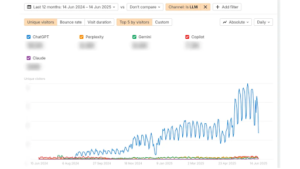
- Gen AI referral traffic is growing 165x faster than traditional organic search.
At first glance this looks catastrophic. But there is a second story hiding inside these numbers.
AI search visitors drove 12.1% of all signups for Ahrefs, despite representing only 0.5% of total traffic, a 23x conversion advantage over organic search.
The visitors who click through from AI platforms are not casual browsers. They have already had a conversation with an AI, refined their requirements, and made a shortlist.
When they land on your site, they are not beginning their research, they are ending it. That distinction changes everything about how CRO should work.
Why AI Search Pre-Qualifies Your Visitors
To understand the shift in traffic quality, it helps to understand what happens before someone arrives at your website in an AI-first world.
Traditional Google search: a user types three words, scans ten blue links, clicks the most promising one, and starts reading. They might be at the very start of their decision process.
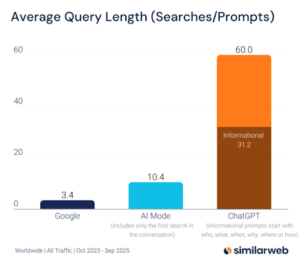
AI search: a user types a detailed question , researchers at Princeton found average AI search queries are now 23 words long, compared to four words on traditional Google. The AI synthesises information from dozens of sources, gives a direct answer, compares options, and surfaces a shortlist. Only then does the user click.
By the time that person reaches your website, the AI has already done the equivalent of a first sales call on your behalf. Or against you, if your product was not included. The implication for CRO is profound: you are no longer optimising to educate strangers. You are optimising to confirm what a partially-decided buyer already suspects.
AI search users type queries averaging 23 words , nearly 6x longer than traditional Google searches.
The Conversion Rate Evidence
The conversion advantage of AI-referred traffic is documented across multiple independent data sets, though the size of the gap varies by platform and industry:
- Seer Interactive analysis (2025): LLM traffic conversion rates , ChatGPT 15.9%, Perplexity 10.5%, Claude 5.0%, Gemini 3.0%. Google’s organic average: 1.76%.
- A 12.3 million visit study across 347 businesses (Superprompt, 2025): AI traffic converted at an average of 14.2% versus Google’s 2.8% , a roughly 5x difference.
- ChatGPT visitors viewed an average of 2.3 pages per session versus 1.2 for Google organic visitors, suggesting deeper mid-funnel engagement. (Seer Interactive case study, 2025)
It is worth being honest about the nuance here. A separate study by Kaiser and Schulze (October 2025) found that for e-commerce specifically, ChatGPT referrals generated lower revenue per session than Google paid search. The picture is not uniform. What is consistent is the intent signal: AI visitors arrive further along the buyer journey, which means they are more sensitive to friction, misaligned messaging, and experiences that do not match their expectation.
How CRO Changes When Visitors Are Pre-Qualified
Traditional CRO operates on the assumption that a significant portion of visitors need convincing. Your job is to build awareness, establish credibility, handle objections, and finally drive a conversion , all within a single visit from a cold audience.
When AI pre-qualifies your traffic, that model shifts in three important ways.
1. From persuasion to expectation alignment
An AI-referred visitor has already been told something about you. Maybe ChatGPT described your product as “best suited for mid-market B2B teams.” Maybe Perplexity mentioned your pricing is transparent but premium. When they arrive, they are checking whether what they were told matches what they find.
If your landing page still opens with a generic headline like “Streamline Your Workflow,” you have a mismatch. The visitor was pre-sold on something specific, and your page is speaking to a different, more general audience. The conversion opportunity is lost before they scroll.
CRO for AI-referred traffic means auditing what AI engines actually say about you , and then aligning your landing experience to confirm those expectations rather than starting from scratch.
2. From reducing friction to removing ambiguity
Traditional CRO wisdom says: fewer form fields, faster load times, clearer CTAs. All of that still matters. But for a pre-qualified visitor, the bigger conversion killer is ambiguity , not friction.
A visitor who arrived from an AI recommendation that described your demo as “a 20-minute personalised walkthrough” will convert poorly if your demo page says “Book a Call” with no further description. They are not confused by the form. They are uncertain whether what they are about to book is the same thing they were promised.
The CRO fix here is clarity, not simplification. Be specific about what happens next. Confirm what the visitor was told about you. Reduce the gap between the AI’s description of your offer and your own.
3. From volume-based testing to signal-based testing
The old CRO model relied on traffic volume to drive statistical significance. But if AI search is sending fewer, higher-intent visitors, traditional A/B testing timelines get longer , and the cost of showing an inferior variant to a genuinely ready buyer goes up.
This is where intelligent testing becomes even more valuable. Multi-armed bandit algorithms that shift traffic toward winning variants faster protect a visitor pool that is now genuinely precious. You cannot afford to waste weeks showing a high-intent buyer a suboptimal experience while waiting for statistical significance. (For a full breakdown of how these algorithms work, see our earlier article: AI for CRO: How Predictive Models and Simple Tests Unlock Hidden Revenue.)
10,000 visitors at 2% conversion rate = 200 leads. The same traffic at 4% = 400 leads. Twice the pipeline. No additional spend.
What This Means Practically: Three CRO Adjustments for the AI Search Era
Adjustment 1: Audit what AI says about you, then match it
Open ChatGPT, Perplexity, and Google’s AI Overviews. Type the questions your ideal customer asks. See how your brand, product, or service is described. Notice the language used, the positioning assumed, the comparisons made.
Now look at your landing pages with that context. Is the language consistent? Does your positioning match? If an AI told someone you are “the tool serious teams use when accuracy matters,” and your homepage talks about being “easy for everyone,” there is a tension that will cost you conversions from exactly the visitors you most want.
Adjustment 2: Design for the arriving expectation, not the arriving stranger
When you know a visitor came from an AI recommendation, you have more context than a traditional organic visitor provides. Use it. If your analytics show that AI-referred visitors land most on a specific product page, treat that page as a confirmation page, not an introduction page.
That means: specific social proof, not generic awards. Real numbers, not vague promises. A CTA that continues the conversation rather than restarting it. The visitor is not starting from zero. Your page should not behave as if they are.
Adjustment 3: Fix the experience gap before chasing more traffic
Many businesses respond to traffic decline by increasing ad spend or doubling down on SEO. Both are valid long-term plays. But if your conversion rate from the high-intent traffic already arriving is poor, spending to acquire more of it is inefficient.
The maths are unambiguous. Improving conversion rate from 2% to 4% doubles your output from the same traffic. In an environment where AI is reducing total click volume but increasing per-click quality, a conversion rate improvement is worth more than it was three years ago. Fix the experience gap first. Understand why pre-qualified visitors are leaving. Then invest in traffic growth.
The Bigger Picture: CRO as a Defence Against Traffic Volatility
The search landscape is not going to become more stable. AI Overviews are expanding. ChatGPT and Perplexity are growing. Search behaviour is fundamentally changing. The businesses that thrive in this environment are not the ones that figure out how to restore 2022 traffic levels , they are the ones that build conversion systems that extract maximum value from whatever traffic arrives.
This is not a pessimistic argument. It is a practical one. Traffic is increasingly outside your control. Conversion is not. The leverage point has shifted.
Sarah’s company did not panic when traffic dropped. They looked at what the remaining traffic was doing, realised these were better visitors than before, and optimised the experience to match. The result was more revenue from fewer visits.
That is the CRO opportunity in the AI search era. Not damage control. Strategic advantage.
When your brand is cited in an AI Overview, your organic CTR is 35% higher than when it is not.
Frequently Asked Questions
Q: My traffic is down but revenue is flat. Is that the AI search effect?
It could be. If your conversion rate is rising as traffic falls, that is a strong signal that the visitors still arriving are higher intent , the lower-intent, casual traffic has been absorbed by AI summaries. The key question is whether revenue per visitor has improved. If yes, you are likely seeing the quality upgrade that AI search creates for remaining clicks.
Q: Should I stop investing in SEO and focus on GEO instead?
Neither replaces the other , this is a both/and, not either/or. Google still sends 345 times more traffic than all AI platforms combined (Ahrefs, 2025). SEO remains essential. GEO (optimising for AI citation) is an emerging layer on top. The right move is maintaining SEO fundamentals while building the content depth and authority that gets you cited in AI responses.
Q: How do I track AI-referred traffic in Google Analytics?
Set up referral source segments for chatgpt.com, claude.ai, perplexity.ai, and bing.com/chat. GA4 does not automatically separate these from other referrals. Once tracked, compare conversion rates, pages per session, and session duration against your organic traffic baseline. The behavioural differences will quickly become visible.
Q: Does this apply equally to e-commerce and B2B?
The intent-qualification effect applies to both, but the mechanisms differ. For B2B, AI tends to assist complex, multi-stage research decisions , so referred visitors arrive with shortlist-level intent. For e-commerce, the picture is more mixed; some data suggests AI referrals convert well for considered purchases (electronics, appliances) but less so for impulse categories. Test your own data before drawing conclusions.
Q: If AI is pre-qualifying my visitors, do I still need to personalise my website?
Yes , arguably more than ever. Pre-qualified does not mean identical. AI visitors arrive from different contexts, with different expectations shaped by what the AI told them. A visitor from a ChatGPT recommendation comparing project management tools needs a different confirmation than one who arrived after asking Perplexity about enterprise security features. Personalisation based on referral source and on-site behaviour remains a high-leverage CRO investment.
References
Ahrefs. (2025). AI Overviews reduce clicks — updated research. Ahrefs.
Barenholtz, L. (2025, May 24). Zero-click searches and how they impact traffic. Similarweb.