
Understand the GEO vs SEO divide
Nearly 60% of Google searches now end without a single click. For every 10 people searching for information about your industry, six of them get their answer directly from Google’s AI Overview, ChatGPT, or Perplexity. Not visiting your website, not your competitors’, not anyone’s.
And it’s accelerating. Online users aren’t browsing through search results anymore. They’re having conversations with AI that synthesizes information from across the web and delivers complete answers. This creates a new dynamic between GEO and SEO.
For most businesses, this shift is invisible until it isn’t. Your rankings hold steady. Your SEO metrics look fine. But traffic quietly erodes, leads slow down, and you can’t quite figure out why. The answer isn’t that your SEO stopped working, but that the game itself has fundamentally changed.
Welcome to the era of Generative Engine Optimization (GEO). If SEO was about being found, GEO is about being chosen: chosen by AI to be the source, the citation, the authority that gets presented to users who never click through to any website at all.
What’s Actually Changing in SEO
The shift happening right now isn’t subtle. The GEO vs. SEO is a major change, and the data tells a story most marketing teams haven’t fully absorbed yet.
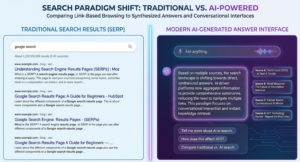
Traditional search engines like Google show you a list of links. You evaluate options, click what looks relevant, compare information across sites, and make decisions. But generative AI engines (ChatGPT, Google’s AI Overviews, Perplexity, Claude, Gemini) fundamentally don’t work that way. They synthesize information from multiple sources and deliver a comprehensive answer directly. Sometimes they cite sources. Often, those citations don’t generate clicks. The user gets what they need without leaving the AI interface.
Research from Princeton University revealed that users write queries averaging 23 words when using AI search, compared to just four words on traditional Google searches. That’s not just longer, but rather represents a completely different behavior. People are having actual conversations with AI, asking nuanced questions they’d never type into a search bar. Questions like “What are the pros and cons of implementing AI-driven marketing for a B2B company with a small team and limited budget?” rather than “AI marketing B2B.”
Current statistics show that 31% of Gen Z searches now happen directly through AI tools rather than traditional search engines. Among all consumers, 58% rely on AI for product and service recommendations. The trajectory is clear: AI replacing part of the search behavior.
In this new world, if your content isn’t structured for AI engines to comprehend and cite it, you’re essentially invisible in this new discovery paradigm. Your perfectly optimized website might rank beautifully on Google, but when half of searches end in zero clicks, ranking means substantially less than it used to.
SEO vs GEO: What’s Different
However, GEO doesn’t replace SEO. They’re complementary strategies that serve different but overlapping purposes. Anyone suggesting you abandon SEO fundamentally misunderstands what’s happening.
Think of the evolution this way. SEO optimized your content for Google’s algorithms and ranking factors. You focused on keyword placement, backlink profiles, domain authority, and technical elements like page speed and mobile responsiveness. Success was measurable: impressions, rankings, clicks, conversions. The path from discovery to conversion was trackable, attributable, and optimizable.
GEO shifts the entire framework. You’re no longer primarily optimizing to rank on a results page that users browse. You’re optimizing to be cited, referenced, and synthesized directly into AI-generated responses. The goal is about becoming the authoritative source that AI engines pull from when answering questions in your domain.
The metrics fundamentally change. Traditional SEO tracked impressions, click-through rates, and conversion paths. GEO requires monitoring citation frequency—how often your brand appears in AI outputs, how you’re being characterized, whether the information AI presents about you is accurate and favorable. It’s an entirely different measurement framework that most analytics platforms aren’t even set up to track yet.
The content approach diverges too. SEO rewarded hitting specific word counts, optimizing keyword density, and building backlinks. GEO favors comprehensive, substantive content that demonstrates genuine expertise through citations, original research, and authoritative voice. Surface-level content optimized for algorithms gets bypassed in favor of depth, accuracy, and demonstrated knowledge.
Perhaps most importantly, the competitive landscape changes. In traditional SEO, you competed for position one through ten on a results page. With GEO, you’re competing to be one of just two to seven sources that AI engines typically cite in any given response. The competition is fiercer, the standards are higher, and the stakes are more severe.
Why Most Websites Are Invisible to GEO
The problem isn’t content quality. The problem is that AI engines process and prioritize information fundamentally differently than traditional search algorithms. A website perfectly optimized for Google’s crawlers might be organized in ways that language models simply can’t parse effectively or don’t weight as authoritative.
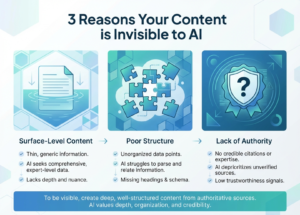
- Here’s what undermines visibility most frequently. First, content remains too surface-level. Traditional SEO created incentives for hitting word counts and maintaining keyword density targets. But AI engines strongly favor comprehensive, authoritative content that fully addresses questions and anticipates natural follow-ups. Your 800-word blog post checking all the SEO boxes isn’t sufficient anymore when AI can synthesize information from multiple, more comprehensive sources.
- Second, content structure lacks the explicit hierarchies and relationships that AI needs to process information effectively. This means rethinking not just what you write, but how you organize information architecturally: section headers, semantic relationships between concepts, logical information flow that language models can follow and extract from.
- Third, and this surprises marketing teams: lack of demonstrable authority. AI engines heavily weight citations, original data, expert quotes, and evidence-backed claims. Marketing copy that makes assertions without substantiation gets deprioritized in favor of content demonstrating genuine expertise with verifiable information. If you’re making claims about your industry without backing them with data, research, or authoritative sources, you’re significantly reducing your chances of being cited.
The Strategies That Actually Work for GEO
So what does effective optimization for AI engines actually look like in practice? The answer combines technical precision with substantial shifts in content strategy.
Start with comprehensive, complete answers. When you create content addressing a topic, cover it thoroughly. If someone asks “What is performance marketing?”, don’t just provide a definition. Explain the methodology, break down key metrics, contrast it with traditional marketing approaches, detail implementation steps, and address common challenges. Think Wikipedia-style depth but written engagingly for humans, not algorithms.
Citations and data become non-negotiable. Research from Princeton demonstrated that adding statistics and citations to content increased visibility in AI responses by over 40%. Every significant claim in your content should include supporting evidence, e.g., industry reports, academic studies, original research, concrete statistics. AI engines treat substantiation as a primary signal of reliability and authority.
Natural, conversational language matters more than ever before. Those old SEO tactics where you awkwardly incorporated exact-match keywords disrupted readability? That actively works against you now. Write the way you’d explain concepts to a knowledgeable colleague. Use the actual questions and phrasing your customers use. AI engines are trained on natural human conversation and reward content that reads authentically.
Structured data and schema markup, previously helpful for SEO, become absolutely critical for GEO. You need to explicitly signal to AI what your content addresses through proper markup: article schema, FAQ schema, how-to schema, product schema where relevant. It’s the difference between AI understanding your content’s purpose immediately versus being uncertain about how to categorize and use it.
One particularly effective approach for GEOs is to create content spanning the entire buyer journey. AI synthesizes information from multiple sources to construct comprehensive responses. If you have well-optimized content covering awareness, consideration, and decision-stage questions, you dramatically increase the likelihood of being cited multiple times within a single AI-generated answer, reinforcing your authority.
The User-Generated Content Advantage
Platforms hosting user-generated content demonstrate significantly higher visibility in AI responses across all major generative engines. Reddit threads appear constantly in ChatGPT outputs. YouTube videos receive heavy citation. LinkedIn discussions and even Quora answers are being integrated into AI-generated responses. The reason? These platforms contain natural, conversational content in formats language models were specifically trained on. AI engines understand the structure, trust the authenticity of diverse perspectives, and favor the organic discussion format.
This fundamentally changes brand strategy beyond owned media. Your presence on these platforms isn’t just community building anymore, but rather ensuring your expertise, brand voice, and perspective are part of the knowledge base AI engines draw from when generating responses. Authentic participation in relevant Reddit communities, creating substantive video content for YouTube, engaging meaningfully on LinkedIn contribute significantly to your overall GEO footprint.
The implication extends to how you think about content distribution. Publishing exclusively on your own website limits your reach in AI-generated responses. Publishing across multiple platforms where people naturally discuss your industry topics, answer questions, and share expertise dramatically expands the likelihood that AI encounters, understands, and references your perspective.
The GEO Reality Check No One Wants to Hear
We’re in the earliest stages of understanding GEO. Unlike SEO, which evolved over two decades with established best practices, clear metrics, and predictable outcomes, GEO is developing rapidly. Strategies effective today might shift as AI models are updated and user behaviors continue evolving.
Aspects of GEO remain frustratingly opaque. Thus far, we lack definitive insight into how AI engines weight different ranking factors. We can’t measure success with the same precision traditional analytics provided. Attribution becomes complex when users never visit your website but are still influenced by how AI presents your brand.
The measurement challenges are real. Traditional marketing operates on clear attribution. With GEO, influence is indirect. Someone asks AI about solutions in your category, receives an answer that positions your brand favorably, and later converts through an entirely different channel. How do you attribute that? Current analytics platforms aren’t equipped to answer that question.
But here’s why that uncertainty shouldn’t paralyze you: the fundamental principles of valuable content creation haven’t changed. If you focus on building genuine expertise, creating comprehensive content thoroughly addressing customer questions, backing claims with evidence, and establishing your brand as a credible information source, you position yourself effectively for both traditional search and AI-driven discovery.
The brands succeeding in this transition aren’t trying to game AI algorithms. They’re building sustainable, long-term content strategies that serve customers regardless of how those customers access information.
What This Means for Your Business Right Now
If you’re a marketing leader or business owner processing this information, you’re probably wondering what concrete actions to take starting tomorrow.
- First, audit existing content through the AI comprehension lens. Is your content genuinely comprehensive or just hitting word counts? Do you include substantive data and authoritative citations? Is content structured with clear hierarchies AI can parse? Would a language model extract accurate, complete information about your expertise from what you’ve published?
- Second, establish baseline tracking for AI visibility. You need to understand your current visibility before you can measure improvement.
- Third, fundamentally rethink content strategy around complete questions rather than individual keywords. Map the full spectrum of questions your customers ask throughout their decision journey. Create content addressing those questions thoroughly, authoritatively, and with substantial supporting evidence.
- Fourth, invest genuinely in building and demonstrating expertise. This transcends marketing copy. Think original research, proprietary data, expert interviews, comprehensive guides, and authoritative resources that other sources cite. Become the source that establishes facts in your domain rather than merely repeating information available elsewhere.
- Fifth, expand your content presence beyond owned media. Engage authentically on platforms where your audience naturally discusses industry topics: Reddit, LinkedIn, YouTube, relevant industry forums. Your visibility in AI isn’t just about your website anymore. It’s about ensuring your expertise exists in the diverse information ecosystem AI engines draw from.
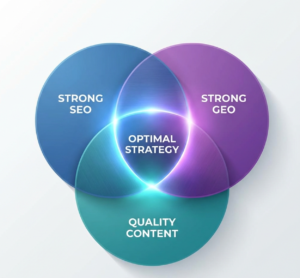
And critically, remember that GEO and SEO aren’t competing strategies. Your objective should be comprehensive visibility across every channel customers use to discover information. That means maintaining strong SEO while layering in GEO optimization. Brands that thrive will be those ensuring they’re findable whether someone searches Google, asks ChatGPT, queries Perplexity, or uses any other discovery method emerging over the next several years.
The Mindset Shift
Perhaps the most significant change is philosophical. SEO trained us to think about traffic, clicks, and conversions as success measures. GEO requires fundamentally different thinking.
Success might mean your content being synthesized into answers where you’re not even directly credited, but your expertise influenced the response. It might mean being cited as one source among several in a comprehensive AI-generated guide. It might mean your brand mentioned consistently when AI recommends solutions to users in your category.
This feels uncomfortable for marketers accustomed to clear attribution models and defined conversion paths. But consider this perspective: if AI consistently references your brand as an authority in your space, positions your solutions favorably in competitive comparisons, and accurately represents your expertise to millions of users, that’s brand building at unprecedented scale. It’s creating top-of-mind awareness across your entire addressable market in ways traditional advertising could never achieve cost-effectively.
The companies adapting fastest to this fundamental shift will establish significant competitive advantages. Not just for upcoming quarters, but potentially for the next decade as AI becomes the primary interface for information discovery across demographics, geographies, and use cases.
The question isn’t whether to invest in GEO. The question is whether you’ll do it proactively, positioning your brand advantageously as this shift accelerates, or reactively, scrambling to recover visibility after competitors have already established themselves as AI-cited authorities in your space.
The window for early-mover advantage is open now. But it’s narrowing as more organizations recognize what’s happening and adapt accordingly.
At Concinnity, we help businesses navigate fundamental shifts in digital marketing. Our AI-Driken Marketing consulting optimizes your content for visibility across both traditional search engines and emerging AI platforms. Want to understand how your brand appears in AI-generated responses? Let’s talk about building a comprehensive GEO strategy that complements your existing SEO efforts.
References
Chen, M. et al. (2025). “Generative Engine Optimization: How to Dominate AI Search”.